
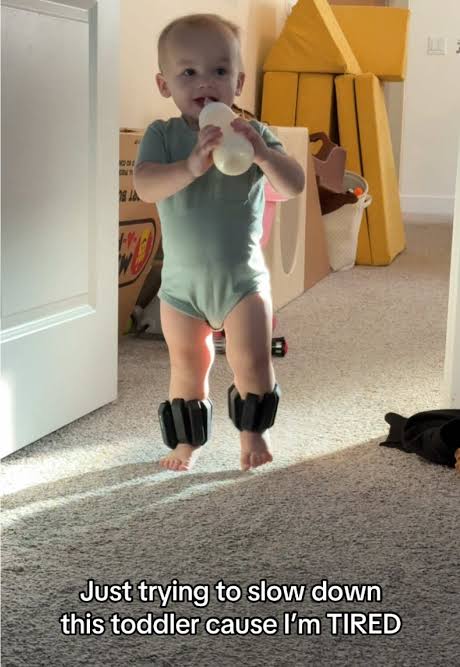
Ankle weights on toddlers are showing up all over social media feeds. Parents are strapping tiny weights onto little legs, thinking it will tire kids out or make them stronger. Doctors are now speaking up loudly, and their message is clear: stop.
The Trend That Has Doctors Talking
So, picture this. Your toddler is running laps around the house at 6 AM. You are exhausted. Someone on the internet says, “Just put ankle weights on them!” And honestly? It sounds almost genius.
But here is the thing. Ankle weights on toddlers are not the harmless hack they seem. In fact, pediatric and podiatric experts are raising serious red flags about this growing trend.
Dr. Dana Figura, also known as Foot Doc Dana, is a Doctor of Podiatric Medicine. She made a widely viewed YouTube Short in April 2026 reacting to this trend. Her verdict was simple and firm: do not do it, especially for toddlers around 18 months old.
So before you reach for those little weighted bands, let us walk through exactly what is happening inside your toddler’s body when you add extra weight to their growing legs.
Understanding the Toddler Body: More Fragile Than You Think
To understand the risks of ankle weights on toddlers, you first need to understand how a toddler’s body actually works.
Toddlers are not just small adults. Their bones, joints, muscles, and nervous systems are still developing fast. Everything is in motion, literally and biologically.
Bones That Are Still Growing
A toddler’s bones are not yet fully hardened. They are made largely of cartilage, which is softer and more flexible than adult bone. This is especially true around the growth plates.
Growth plates, also called epiphyseal plates, are areas of soft, developing tissue near the ends of long bones. These are the places where new bone tissue grows. Because they are soft, they are also the most vulnerable parts of a child’s skeleton.
Adding extra weight, like ankle weights on toddlers, puts abnormal stress on these growth plates. That stress can disrupt normal bone development. In some cases, it can even cause deformations that affect how a child walks and moves for the rest of their life.
Sources like the American Academy of Pediatrics (AAP) have long emphasized protecting young children from unnecessary physical stress on developing bone structures. You can read more from the AAP on child development here.
Muscles That Are Still Learning
A toddler’s muscles are also in a learning phase. Every step they take is a lesson. Their bodies are figuring out which muscles to use, how much force to apply, and how to balance movement with gravity.
This process is natural, precise, and amazingly efficient. The body knows what it is doing. However, when you introduce ankle weights on toddlers, you interrupt this natural classroom.
Muscles that would normally grow in balance now have to compensate for extra resistance. Some muscles may overdevelop. Others may be underused. This imbalance can create problems that show up later, sometimes years down the road.
A Nervous System Still Building Its Map
The nervous system is the control center for movement. In toddlers, it is still building the neural pathways that coordinate movement.
Every time a toddler takes a step, the brain records that pattern. It learns how much effort is needed, how to balance, and how to correct a stumble. Over thousands of steps, this builds into what we call coordination and motor skill.
Ankle weights on toddlers change the input the nervous system receives. The body learns to walk a certain way with the extra weight. Then when the weights come off, the brain has to unlearn those patterns. That transition can cause instability, over-striding, or awkward movement.
The Science of Gait: Why Walking Is More Complex Than It Looks
Walking looks simple. But biomechanically, it is one of the most complex movements the human body performs.
Gait, which is the technical term for how we walk, involves coordinated input from the brain, spinal cord, muscles, joints, tendons, ligaments, and even the inner ear. All of these systems work together every single step.
Toddlers are still mastering this system. Between 12 and 24 months, children go through enormous changes in how they walk. They shift from a wide, wobbly stance to a more upright and coordinated gait. Their center of gravity shifts as their proportions change.
How Ankle Weights Disrupt the Gait Cycle
The gait cycle has several phases: heel strike, mid-stance, push-off, and swing phase. Each phase relies on specific muscle activation and joint angles.
Ankle weights on toddlers add resistance during the swing phase, which is when the leg lifts and moves forward. This changes how high and how fast a child lifts their leg. It also alters the timing and coordination of each gait phase.
A study referenced by Dr. Figura in her YouTube Short shows that even small amounts of added weight can modify a child’s walking pattern. These modifications are not always obvious at first. But over time, they can become habits that are very hard to correct.
Think of it like this. If you wore a shoe on the wrong foot for months, your body would start adapting to that wrong pattern. Fixing it later would take real effort.
Joint and Growth Plate Risks: A Closer Look
Now let us dig deeper into one of the most serious concerns around ankle weights on toddlers: joint and growth plate injury.
Toddler joints are soft, flexible, and designed for natural movement. They are not designed to handle added external loads. When you strap weight onto a toddler’s ankle, every step sends a small jolt of extra force up through the ankle, into the knee, and then into the hip.
Over time, that extra force adds up. Here is a quick look at the joints most affected.
The Ankle Joint
The ankle is a hinge joint made up of three bones: the tibia, fibula, and talus. In toddlers, these bones are still forming. The cartilage in the ankle is softer and more pliable.
Extra weight at the ankle increases the load on this joint with every step. This is especially concerning during the push-off phase, when the calf muscles lift the heel and push the body forward.
Overloading the ankle at this age can lead to inflammation, micro-stress in the cartilage, and altered joint development.
The Knee Joint
The knee is one of the body’s most complex joints. It handles enormous forces even during normal walking. In toddlers, the knee is still developing its structure, ligament strength, and alignment.
Adding ankle weights on toddlers increases the force traveling through the knee with every step. The knee ligaments, especially the anterior cruciate ligament (ACL) and posterior cruciate ligament (PCL), are not fully mature in toddlers. That means they are more susceptible to strain.
The Hip and Pelvis
Force does not stop at the knee. It travels up into the hip joint and then into the pelvis. The hip in a toddler is still going through significant structural changes. The femoral head, the ball part of the ball-and-socket hip joint, is still developing its shape and angle.
Extra loading from ankle weights on toddlers affects how the femoral head sits in the hip socket. Over time, this can affect alignment and movement quality well into childhood and adulthood.
Balance and Coordination: Skills That Cannot Be Rushed
One of the most important things toddlers are learning is how to balance. Balance is not just about not falling. It is about proprioception, which is the body’s internal sense of where it is in space.
This sense is built through movement. Every stumble, every recovery, every step on an uneven surface teaches the body something. That information gets stored in the nervous system and builds into confident, coordinated movement.
Ankle weights on toddlers interfere with this process in a few important ways.
First, the extra weight changes the sensory input the ankles and feet send to the brain. The body is getting inaccurate information about where the foot is and how much force is being used.
Second, when weights are removed, the body suddenly has to readjust. Children may over-stride, stumble more, or move awkwardly as the nervous system recalibrates.
Third, the learning process gets disrupted. Instead of building natural balance patterns, the child is building weight-assisted patterns that do not transfer cleanly to normal movement.
According to general pediatric movement guidelines, children develop balance and coordination best through free, unrestricted play. You can find more about healthy motor milestones at CDC’s child development page.
What the Research Actually Says About Ankle Weights on Toddlers
Here is something parents really need to know. There are no peer-reviewed studies showing that ankle weights on toddlers provide any developmental benefit for healthy children.
Not one.
The research that exists on weighted training in children is limited to therapeutic settings. Physical therapists sometimes use controlled, supervised weight resistance for children with specific medical conditions, like cerebral palsy or certain motor delays. But this is done carefully, under professional guidance, and with specific rehabilitation goals in mind.
That context is very different from strapping weights on a healthy toddler at home because they have too much energy.
Dr. Figura pointed this out directly in her YouTube Short on the topic: Watch the video here.
Without evidence of benefit, and with evidence of real risk, the case against ankle weights on toddlers becomes very strong, very quickly.
The Myth of “Tiring Out” Your Toddler
Let us talk about the real reason most parents are trying this trend. They are exhausted. Their toddler has energy that seems physically impossible for a small human. And they just want five minutes of peace.
That is completely understandable. Parenting a high-energy toddler is genuinely hard work.
But ankle weights on toddlers are not the answer for a few reasons.
First, toddlers are remarkably good at adapting. Their bodies adjust quickly to new challenges. So even if the weights made them slightly more tired at first, that effect would likely fade within days as their muscles adapted.
Second, the fatigue you are chasing is muscular fatigue. But the risks you are introducing affect bones, joints, and neurological development. That is not a trade-off worth making.
Third, there are much better and safer ways to tire out a toddler. And they do not come with any of the downsides.
Better Alternatives That Actually Work
Instead of reaching for ankle weights on toddlers, try these evidence-backed alternatives that support healthy development and also help wear out your little one.
Unstructured Outdoor Play
Nothing tires out a toddler quite like running around outside. Grass, sand, hills, and uneven terrain naturally challenge balance and coordination in healthy ways. This is exactly the kind of movement toddlers are designed for.
Unstructured play also gives children the freedom to explore their physical limits at their own pace. That self-directed movement builds confidence and motor skill in ways that structured exercise simply cannot replicate.
Sensory Play Stations
Sensory bins, water tables, and sand play engage toddlers both physically and mentally. They may not run as many laps, but this kind of play uses fine motor skills, problem-solving, and focus, which are all equally important for development.
Dance and Music
Put on some music and let your toddler go wild. Dancing engages the whole body, builds coordination, improves rhythm and timing, and is genuinely exhausting for most toddlers. As a bonus, it is fun for everyone.
Indoor Obstacle Courses
Use pillows, cushions, tunnels, and low balance beams to create a safe indoor obstacle course. Toddlers love these, and they provide fantastic motor challenges without any added resistance or risk.
Outdoor Walks and Nature Hikes
Even short walks on varied terrain give toddlers a great workout. Let them set the pace and stop to investigate every rock and bug. The meandering nature of a toddler walk is actually great for their development.
Baby Gates and Safe Zones
Sometimes you just need a break. Using a safely enclosed space where your toddler can play freely is a legitimate and responsible choice. You are not failing as a parent because you needed five minutes to breathe.
When to Talk to a Doctor
Sometimes a toddler’s movement or development genuinely does cause concern. If you notice any of the following, it is a good idea to talk to your pediatrician or a pediatric physical therapist.
Your child is not walking by 18 months. Your child walks in a very unusual pattern. Your child seems to have significant balance problems. Your child frequently falls in ways that seem beyond typical toddler clumsiness.
A professional can assess your child properly and, if needed, recommend appropriate therapeutic interventions. These may occasionally include supervised weighted training, but only in specific clinical contexts and with professional oversight.
The key word there is professional. Ankle weights on toddlers at home, without that professional guidance, are a completely different thing.
You can also reach out to resources like the American Physical Therapy Association for guidance on finding a qualified pediatric physical therapist.
The Social Media Problem: Trends vs. Evidence
It is worth stepping back and talking about the bigger picture here. Social media has created an environment where parenting trends spread faster than the research can evaluate them.
Parents are not bad people for trying ankle weights on toddlers. They saw a video, it seemed reasonable, and they gave it a shot. That is human.
But the speed of social media means that harmful trends can reach millions of parents before any medical authority has a chance to weigh in. By the time doctors are reacting, the trend is already widespread.
This is exactly what happened here. Dr. Figura’s video was a reaction to a trend that had already gone viral. Her reaction was clear and urgent because the risk is real, and she wanted parents to hear the warning before more children were affected.
Being a critical consumer of social media parenting content is increasingly important. Before trying any trend that involves your child’s physical body, especially their developing bones and joints, look for medical backing. If you cannot find a reputable source recommending it, that silence is itself a signal.
A Note on the Parenting Pressure Behind This Trend
One more thing deserves attention. The fact that ankle weights on toddlers became a trend at all says something interesting about the pressure modern parents feel.
Parents today are bombarded with messages about optimizing their children. Start early. Get ahead. Make sure they are developing faster, better, stronger. It is exhausting, and it creates a climate where something like ankle weights on toddlers can sound like a smart developmental hack rather than a risky shortcut.
Here is the truth, though. Toddlers do not need to be optimized. They need to play. They need to explore. They need loving, attentive adults who let them move freely and safely.
The best thing you can give your toddler is time to be a toddler. Free movement, safe spaces, and unstructured play are the real ingredients of healthy development. No weights required.
Quick Summary: What You Should Remember
Ankle weights on toddlers disrupt natural gait development and can create lasting movement habits that are hard to fix. They put stress on soft, developing growth plates and joints that are not ready for extra loads. They interfere with the balance and proprioception skills toddlers need to build naturally. There is no peer-reviewed evidence supporting their use for healthy toddlers. Safer alternatives exist that achieve the same goal without any of the risks.
Dr. Figura’s message, and the message of pediatric and podiatric professionals broadly, is not to shame parents. It is to protect kids.
Final Thoughts
Ankle weights on toddlers might seem like a quirky life hack from the internet. And in a world full of parenting advice, it is easy to see how they gained traction. But the science is clear on this one.
Toddlers are in one of the most critical windows of physical development in their entire lives. Their bones, joints, muscles, and nervous systems are building patterns that will last for decades. Disrupting that process with added weight, without any professional guidance or proven benefit, is a risk no parent needs to take.
So the next time you see a social media trend involving ankle weights on toddlers, feel free to scroll right past it. Let your toddler zoom around the living room the way nature intended. Loud, chaotic, and entirely weight-free.
Sources and Further Reading
- Dr. Dana Figura (Foot Doc Dana), YouTube Short: “Doctor reacts: ankle weights for toddlers?!” April 2026. Watch here
- American Academy of Pediatrics (AAP): Guidance on toddler motor development and injury prevention. Visit AAP
- Centers for Disease Control and Prevention (CDC): Child Development Milestones. Visit CDC
- American Physical Therapy Association (APTA): Finding a pediatric physical therapist. Visit APTA
- Biomechanics research on weighted gait training in children: Limited to therapeutic, supervised use in clinical settings. General review available through PubMed
- General guidance on safe toddler play and development: Zero to Three